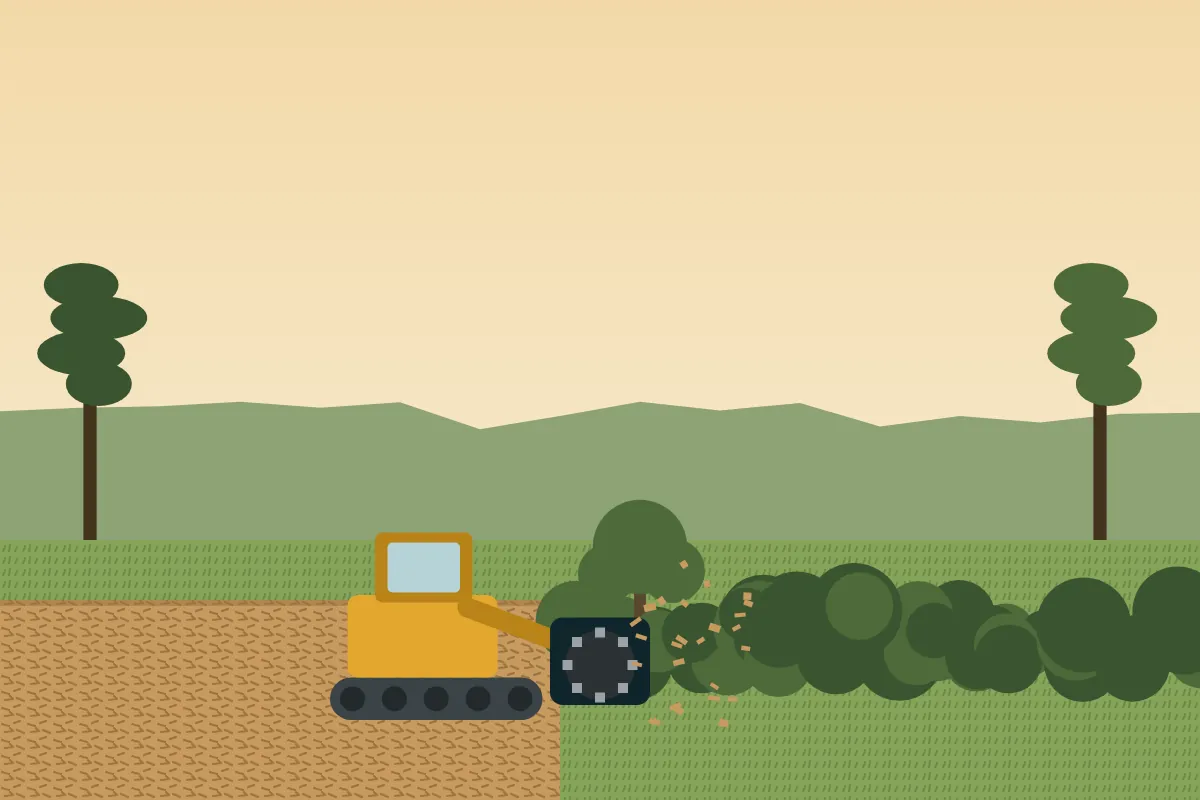
When mulching is the right call
| Your situation | Why mulching fits |
|---|---|
| Thick brush, privet and tallow you can't walk through | The mulcher chews through it without piles to burn or haul |
| You want to keep the bigger oaks and pines | Operators can work around trees you mark |
| Wet or low ground | Tracked machines spread their weight and leave the topsoil in place |
| Trails, fence lines, deer stands and shooting lanes | Narrow strips cleared quickly without disturbing the rest |
| Land you'll mow or use as pasture later | The chip layer breaks down and grass can come back |
How a mulching job usually goes
- Walk-through: the operator looks at what's growing, how big the trees are, the ground, the gate width and anything buried.
- Marking: you flag trees to keep, property lines and anything to avoid, like septic lines, wells or old fences.
- Mulching: the machine works across the area. Thick ground may need a second pass to get chips finer.
- Finish: some companies offer a lighter finishing pass or touch-up with a saw around kept trees.
Stumps are usually ground to around ground level, not pulled out. If something will be built on the spot, see site prep and dirt work.
Choices that change the price and the result
- Tree size: most mulchers handle brush and trees up to a certain trunk thickness. Bigger trees may need felling first; ask each company where its limit is.
- How fine: a rough pass is faster and cheaper; a fine finish costs more.
- What stays: keeping lots of scattered trees slows the machine down.
- Access: machines need a way in. Gate width, ditches and soft ground near the road all matter.
- Ground conditions: after a wet week, many crews wait rather than rut up your land.
Questions worth asking
- What machine will you bring, and what's the biggest tree it'll take down?
- Do you price by the acre, by the hour or by the job?
- How deep will the chip layer be, and will grass come back through it?
- How will you handle the trees I want to keep?
- What happens if it rains on the day you're booked?
Common around the capital region
Around Baton Rouge, a lot of mulching requests are for tallow (popcorn) trees and privet that took over old pasture, backyard strips along drainage ditches, and wooded lots in Livingston and Ascension parishes that owners want opened up without tearing up the ground.
Questions people ask
Will the mulch kill the grass or wash away?
A thick layer can slow grass for a season, and very heavy rain can move loose chips on a slope. Ask how deep the layer will be and whether a finer pass makes sense for your plans.
Do the stumps come out?
Usually not. Mulching cuts stumps near ground level. If you need stumps gone, ask about stump grinding or removal as a separate step.
Can you mulch around my big oaks?
Yes, that's one of the main reasons people choose mulching. Mark the trees you want kept and walk the property with the operator.